
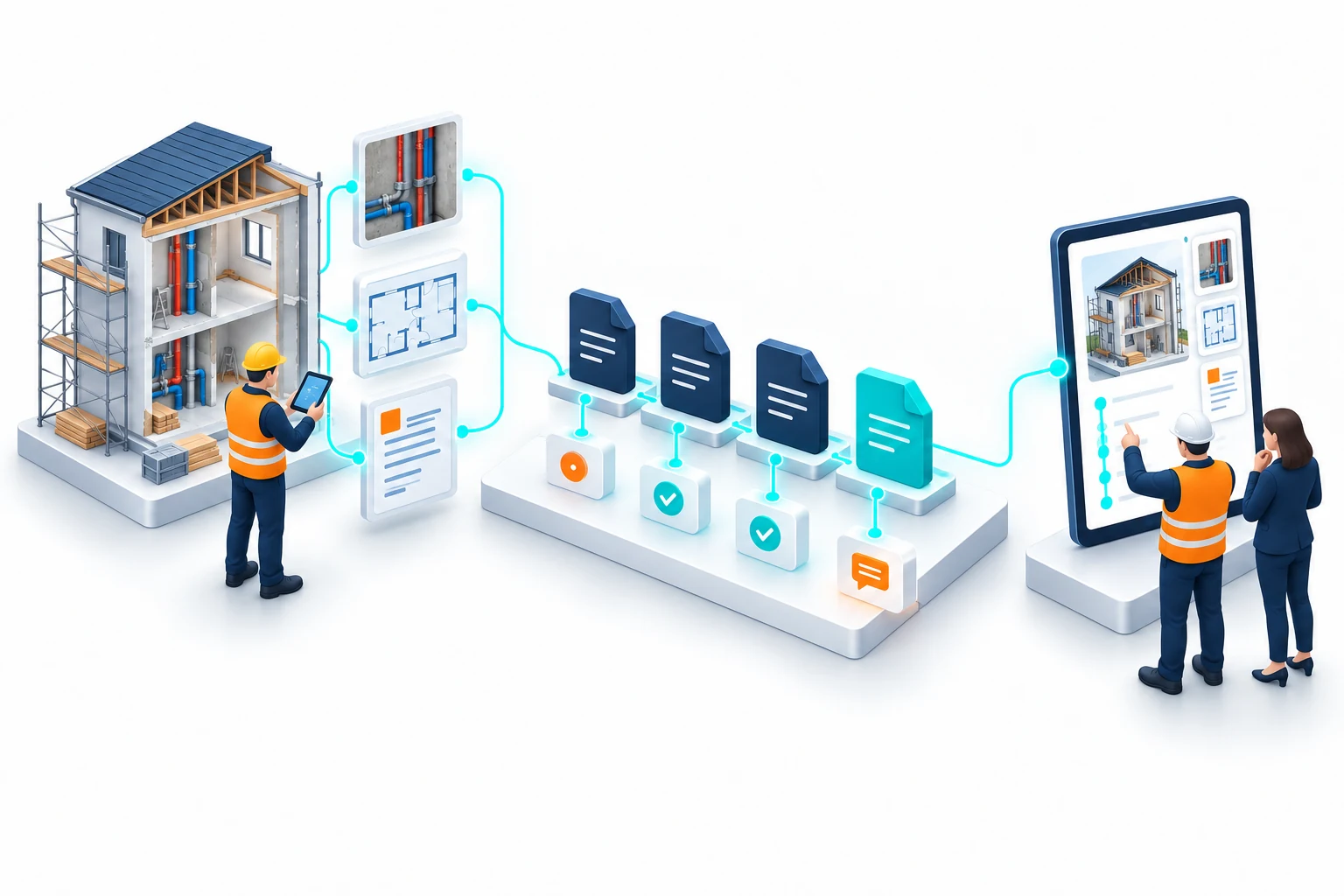
From the site to the reference record
On a construction project, part of the story is in a quotation. The rest is in phone photos, conversations with the client, a revised plan or the site manager’s notes. Each person holds part of the record. When everything goes well, this fragmentation goes unnoticed. At the first misunderstanding, it becomes a search task.
NordLeadBTP, the company behind ChantierLink Pro, and StratoFoundry, which develops KARL Core (memory layer), are working together on this problem. Their partnership aims to make construction follow-up practical in day-to-day use and give retained information an examinable history.
Connecting documents and decisions
The challenge is to organise sometimes extensive records, with many files and related information, across the company’s teams, tools and storage systems. Finding a document is useful; knowing which project it belongs to, which version was circulated and which decision relates to it makes it possible to follow the story. Their partnership addresses this need.
Consider the common case of a client requesting a change during a renovation. A conversation clarifies the need, a quotation is revised and the work moves forward. A few weeks later, a question arises about the price or the planned scope. The problem is not necessarily a missing document. It is finding the correct version, the request that prompted it and the record of any acceptance.
ChantierLink Pro provides the business context in which these elements belong: the project, its participants, the documents, decisions, handover and outstanding issues. KARL Core provides a memory of decisions and the data’s decision history by structuring stored objects, their versions and their relationships. It brings practical site expertise together with the administrative rigour a complex project can require.
The designer’s perspective
On a construction project, keeping documents is not enough: we need to understand what was agreed, which version was accepted and what still needs to be completed.
We chose StratoFoundry and its KARL Core Memory Layer to build this continuity. It allows us to connect documents, events and decisions in a structured, traceable memory.
Our ambition with ChantierLink is simple: to enable professionals and their clients to find the information they need, understand its history and have a verifiable record at every stage of the project.
Discover ChantierLink Pro
Sharing the decision history
This complementarity extends to the Evidence Packs supplied by StratoFoundry. Their role is to reproduce the relationships and states recorded in the memory layer: which decisions were made, by whom, when and with what consequences. This forms the immutable decision history of the project. Source files can remain on their storage systems; the pack carries the memory structure that places them in context and makes it possible to verify the elements within its scope. A pack may therefore cover a work stage, a change or the follow-up of an outstanding issue. Its value lies in the verifiable preservation of the links and states that give the history meaning.
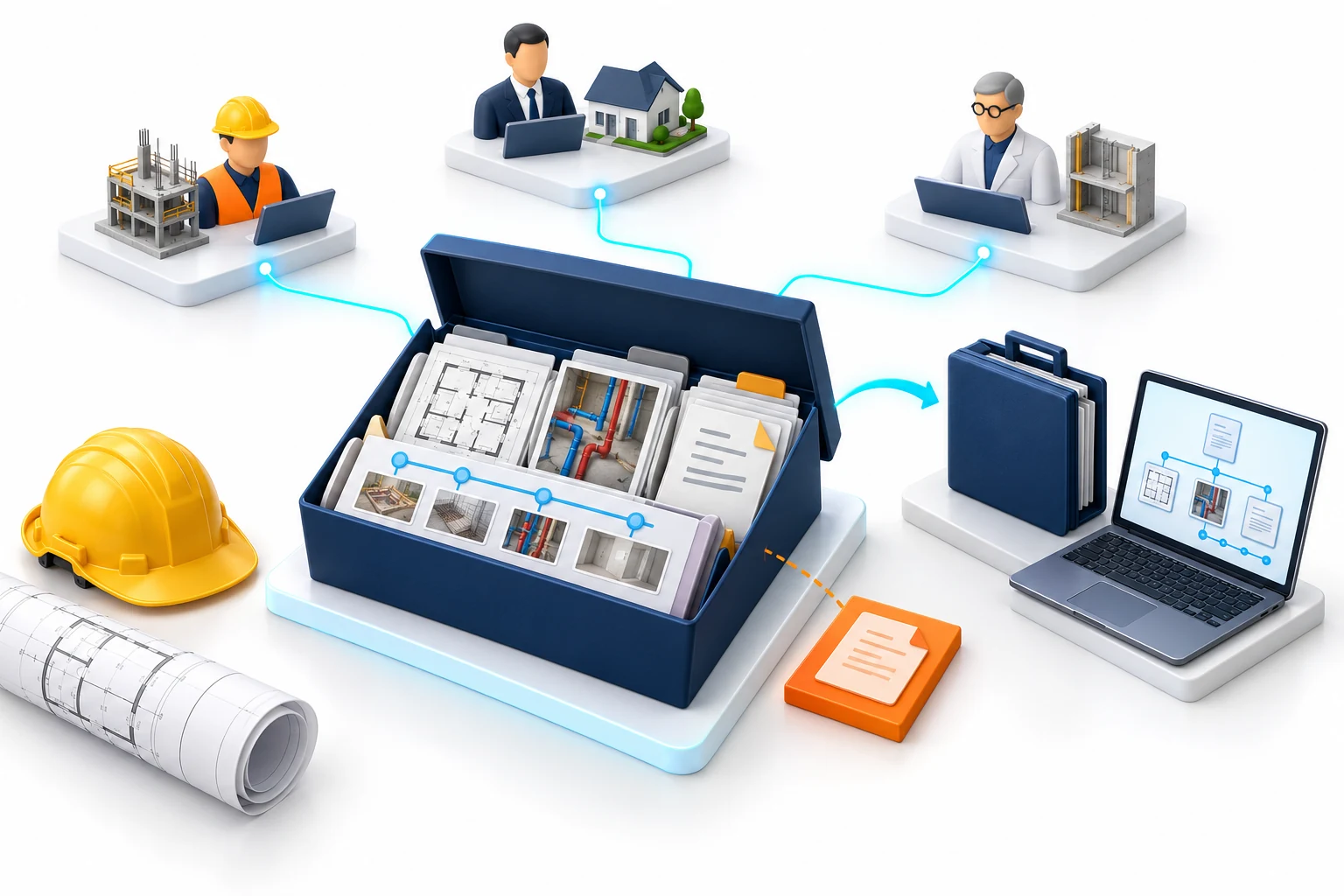
A photo of pipework before it is enclosed, for example, becomes useful when it is linked to the correct intervention and accompanied by context, including the date, location and photographer. Likewise, reporting an outstanding issue, taking a photo of corrective work and receiving client acceptance are distinct events. Keeping them separate prevents work declared complete from being confused with an issue that has actually been resolved and accepted.
This precision matters to everyone involved. The contractor can document the work and find the details of a discussion without reconstructing weeks of exchanges. The site manager can pick up a record or hand it over to a colleague using a lightweight Evidence Pack, without moving all the source files. The client has a readable, complete and focused history. A project supervisor or expert can examine the documents shared with them alongside the full decision history.
Distinguishing permissions and approvals
The reference record is not accessible in the same way to everyone. Companies working on the same project have different roles and access rights.
The solution must allow each person to consult the documents relevant to them, within the agreed permissions. Preparing a record for a client, subcontractor or expert does not mean giving them access to every project archive.
Trust also depends on precise language. Verifying that a file has not changed does not guarantee that its contents are accurate or that a client has accepted them.
Each decision must be linked to the person who made it, the subject concerned and the corresponding document. Disagreements and pending approvals must remain visible. A record is more credible when it clearly distinguishes confirmed facts from those still to be verified.
For NordLeadBTP and StratoFoundry, this requirement guides the development of the solution. On site, collecting information must not slow down the work. The solution must then preserve the different versions, their relationships and their states.
Exported data must remain useful outside the interface that produced it. This is why offline verification of KARL Core Evidence Packs is central to the collaboration.
Verifying the project’s memory without connecting to the service
The principle is to be able to examine an Evidence Pack on a disconnected computer, without signing in to ChantierLink Pro or querying the KARL Core service. The local verifier must have the pack, the necessary trusted public keys and verification rules compatible with its format. It can then check the signatures and integrity of the exported data, along with the relationships and states included within the pack’s scope.

Offline verification remains possible after access to the service has been removed, provided the pack and necessary material were saved beforehand.
It does not automatically provide access to the original documents. To read their contents or compare their hashes, the relevant files must also be available.
Finally, verification covers only the state of the pack at the time of export. It does not reveal events or revocations that occurred afterwards.
Keeping a useful record after the work ends
A construction record remains useful after the work has ended. A question may arise after handover, a contact person may change or a company may adopt different software.
The client must therefore be able to retain information that they can consult and use. The contents of the export and the retention rules must be clearly defined.
The partnership also gives each company a clear area of work. NordLeadBTP brings the uses of ChantierLink Pro and the simplicity required for construction follow-up. StratoFoundry brings KARL Core and the verifiable memory mechanisms that support this approach. The solution is being built where these contributions meet: information captured in the course of work, then organised so it can be found, understood and shared.
The promise of ChantierLink Pro with KARL Core lies in this continuity. A construction project produces buildings, but also choices, commitments and observations. By preserving their history in a verifiable reference record, the two partners aim to give professionals and their clients a shared basis for following the work and answering questions that arise later.