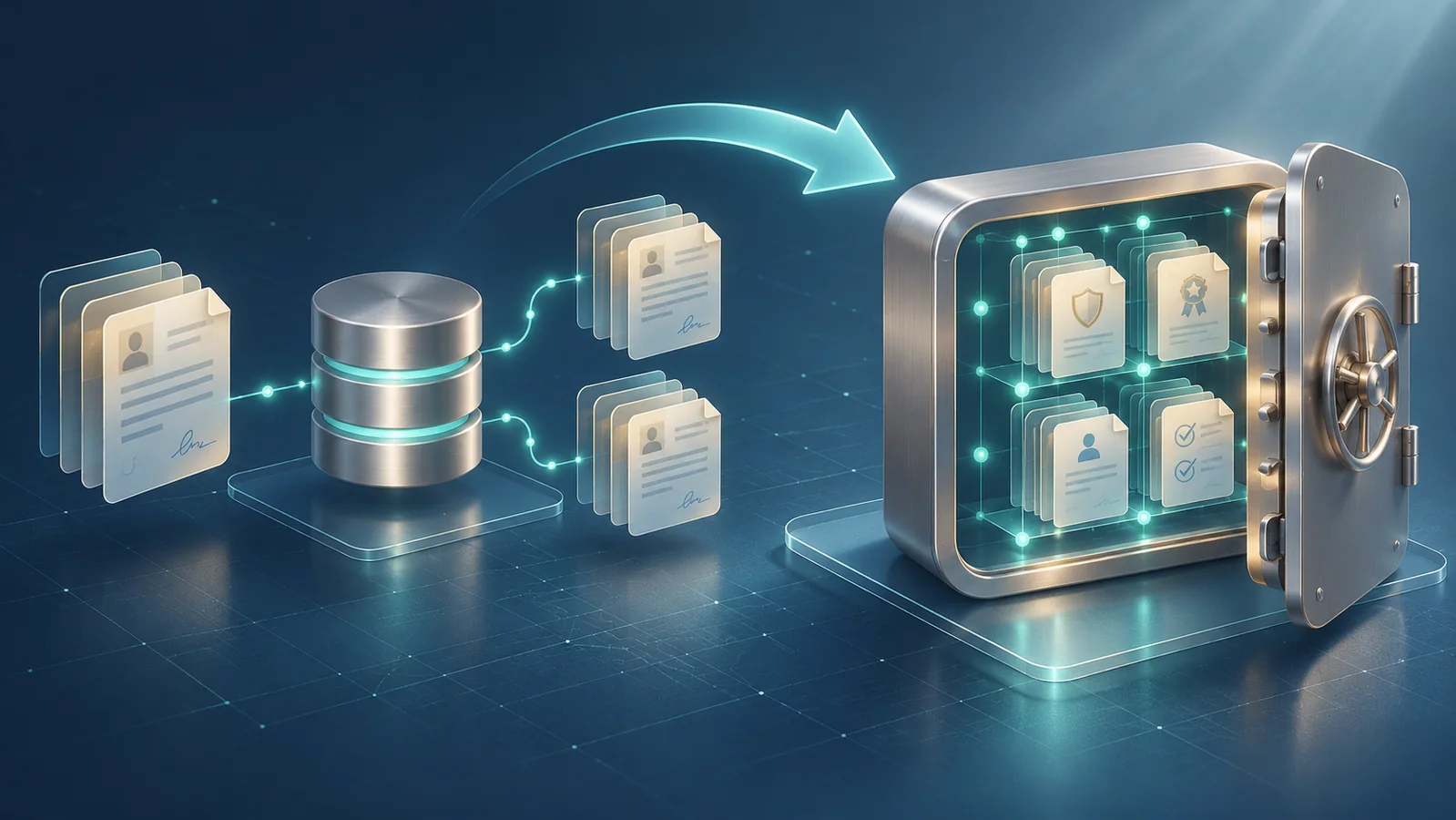
Traditional document management solutions rely on a database that describes what is stored elsewhere. This indirection long seemed unavoidable; today, it is a major source of operational risk.
The structural problem with intermediate databases
- the database and the storage can fall out of sync;
- the database becomes the weak link in the event of corruption;
- backups for both components must be coordinated;
- scaling becomes costly;
- operational costs increase with volume.
In the event of an incident, the immediate question becomes: 'is the database consistent with the storage?'
Teams must then check whether the database and storage are in sync.
S3 as a single source of truth
S3 has become a universal standard. It natively provides:
- durability;
- object versioning;
- object locking (Object Lock / WORM);
- fine-grained access policies;
- compatibility with a wide range of providers.
When utilised correctly, S3 can independently handle metadata, history, and immutability, eliminating the need for an external database.
KARL and the native S3 approach
KARL relies directly on S3, without an intermediate database. All information — versions, metadata, and histories — is stored as versioned objects.
This architecture offers:
- a simpler architecture;
- reduced operational costs;
- guaranteed consistency;
- total portability;
- inherent resilience to infrastructure incidents.
Data once again becomes the source of truth, rather than a representation of it.
Further reading
To learn more:
Read the Challenges article on KARL →